
Hot water, restored
Water Heater Repair in San Francisco
No hot water or a leaking tank? Get practical water heater help fast. Call us.
Hot water, restored
No hot water or a leaking tank? Get practical water heater help fast. Call us.
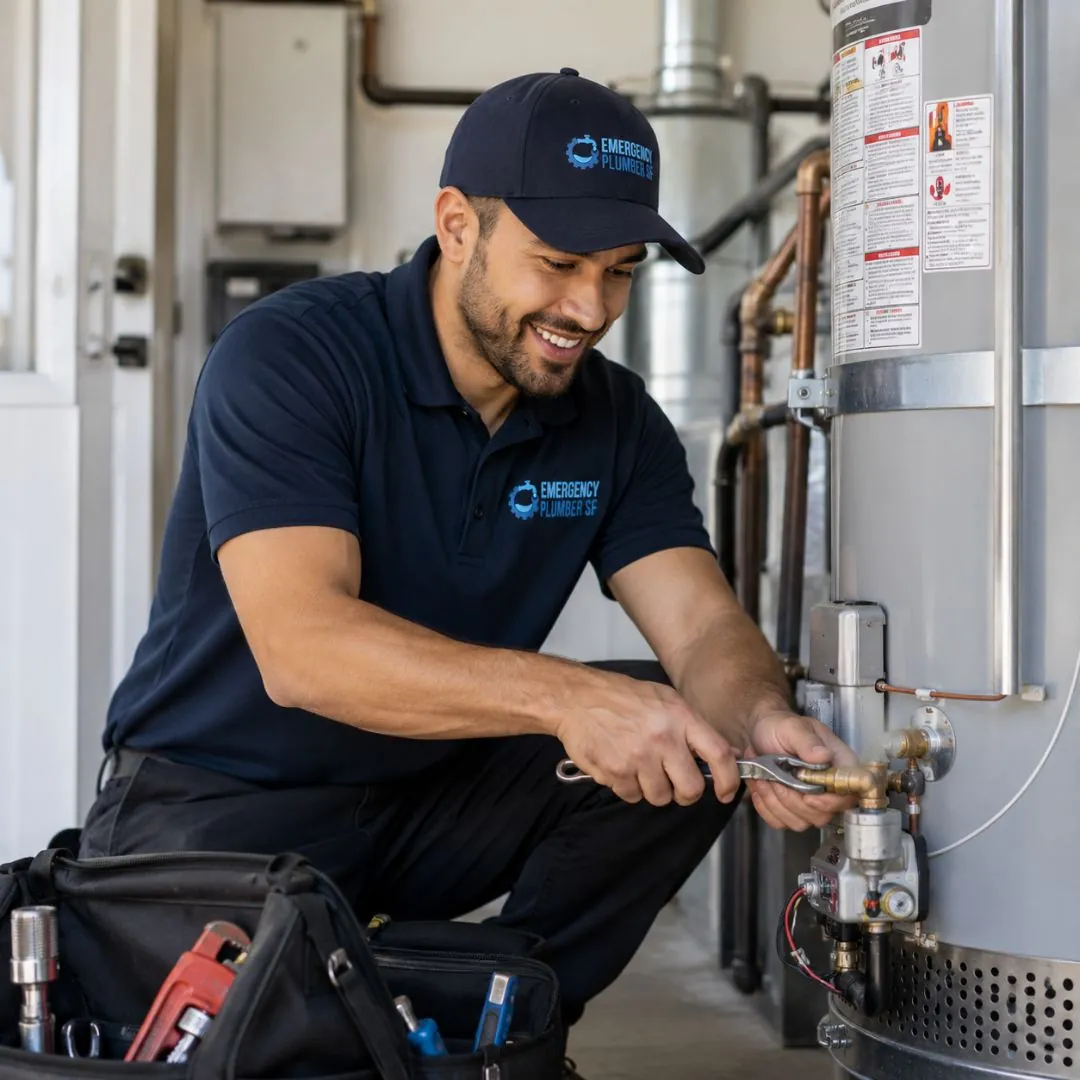
When a water heater fails, daily life gets disrupted fast. Showers, dishwashing, laundry, and business operations all stop. Emergency Plumber SF repairs standard tank systems and tankless water heaters throughout San Francisco and nearby service areas, usually the same day.
We handle no hot water, inconsistent temperature, visible leaks, strange noises, pilot and ignition problems, pressure relief valve issues, supply line leaks, and emergency shutoff concerns. Our technician inspects the system, explains the likely problem, and gives you an honest answer to the question that matters most: repair or replace?
Some water heater issues are simple and cheap. Others point to age, corrosion, unsafe pressure, or tank failure. We evaluate the full picture so you're not paying for a repair that doesn't solve the real problem, or replacing a unit that had years left in it.
We check pilot, ignition, gas supply, power, thermostats, and heating elements. The diagnosis depends on your unit type, and we explain what we find.
We determine whether the leak comes from a fitting, valve, supply line, drain valve, relief valve, or the tank itself. Only one of those means replacement.
Tankless units fail from flow problems, scale buildup, ignition faults, venting issues, or error codes that need proper diagnosis, not guesswork.
Loose, corroded, or failed connections can leak around a heater even when the tank is perfectly good. These are usually quick, inexpensive fixes.
When the unit is unsafe, past its lifespan, or leaking from the tank, we lay out replacement options and costs clearly, with no pressure.
The decision turns on three things: the age of the unit, what has failed, and whether the tank itself is leaking. The third one settles it on its own.
A leaking tank is not repairable. Once the inner vessel has corroded through, no part replacement fixes it, and a weeping tank becomes a failed tank on its own schedule. Everything else is potentially a repair: thermocouples, heating elements, thermostats, gas control valves, pressure relief valves, and anode rods are all serviceable parts.
Age is the next factor. A conventional tank typically lasts eight to twelve years in this area, tankless considerably longer. Spending several hundred dollars on a nine-year-old tank buys you an uncertain amount of time; the same money against a replacement is better value. Under about six years, repair almost always wins.
| Symptom | Likely cause | Usual answer |
|---|---|---|
| No hot water, gas unit | Pilot, thermocouple, or gas control valve | Repair |
| No hot water, electric unit | Heating element or thermostat | Repair |
| Not enough hot water | Sediment build-up, failed lower element, or undersized unit | Flush, repair, or resize |
| Rumbling or popping | Sediment on the tank floor | Flush, and expect reduced remaining life |
| Water around the base | Fitting, relief valve, or the tank itself | Investigate; tank failure means replacement |
| Rusty hot water | Anode rod exhausted, tank corroding | Anode replacement if early, otherwise replace |
| Relief valve discharging | Excess pressure or temperature, or a failed valve | Repair, and check incoming pressure |
Two California-specific requirements catch people out on replacement. Water heaters must be seismically strapped, with two straps bracing the unit at the upper and lower thirds, and a replacement that leaves out the strapping is not compliant. Replacement also generally requires a permit through the Department of Building Inspection. Both cost little; skipping either creates a problem at resale when an inspector asks for the permit history.
Flushing deserves a mention as the maintenance nobody does. Sediment settles on the tank floor, insulates the burner from the water, and makes the unit work harder while accelerating corrosion. Draining a few gallons annually takes fifteen minutes and measurably extends the life of the tank.
| Service | Typical Range | Average |
|---|---|---|
| Water heater diagnostic | $125–$300 | $200 |
| Minor valve or connection repair | $200–$650 | $375 |
| Ignition, element, or thermostat repair | $250–$800 | $500 |
| Tankless water heater service | $300–$1,000+ | $650 |
Costs vary by unit type, age, access, parts, and code requirements. If replacement is safer or cheaper than repair, we'll show you the math.

We look for sensible repair options before recommending replacement, and explain the reasoning either way.
Our team services standard storage tank water heaters and tankless systems from all major brands.
We pinpoint whether a leak is a $200 fitting or a failing tank, so you make the right call.
We explain shutoff, pressure, venting, and code concerns in plain language: the things that keep a water heater safe, not just working.
If the tank itself is leaking, replace, because a corroded vessel cannot be repaired. If the unit is under about six years old and a serviceable part has failed, repair. Between six and twelve years it is a judgement call: weigh the repair cost against the remaining life, and if the repair is more than roughly half the replacement cost on an older unit, replacement is usually better value.
Eight to twelve years for a conventional tank in this area, and often fifteen to twenty for tankless. Water chemistry, whether sediment was ever flushed, and whether the anode rod was replaced all move that considerably. Check the manufacture date on the data plate rather than guessing, since it is frequently older than people assume.
It depends on your building. Tankless delivers unlimited hot water, lasts longer, and saves space, which matters in San Francisco where a garage or closet footprint is valuable. The costs are a higher purchase price, usually a gas line upgrade and new venting, and a more involved installation. In a flat with a tight utility closet the space saving alone sometimes justifies it.
Yes. Water heaters must be braced against earthquake movement, with straps at the upper and lower thirds of the unit anchored to the structure. Any compliant replacement includes it. If your existing unit is unstrapped or has a single strap, that is worth correcting regardless of whether you are replacing it, and it is inexpensive to do.
Generally yes, through the Department of Building Inspection. The permit covers the installation, the seismic bracing, venting, and the connections. It costs little relative to the job. Skipping it saves nothing meaningful and creates a documentation gap that surfaces when the property is sold and an inspector asks about the permit history.
Usually sediment. It accumulates on the tank floor, occupying volume that used to hold water and insulating the burner from it, so the unit heats less efficiently and delivers less. A flush often helps. On an electric unit a failed lower element produces the same symptom, since the upper element alone heats only part of the tank.
Draining several gallons from the tank's drain valve to clear accumulated sediment. Once a year is a reasonable interval, more in hard water. It takes about fifteen minutes and measurably extends tank life by reducing corrosion and keeping the burner working against water rather than a layer of grit. It is the single most neglected maintenance item in the house.
For a tank, it is driven by peak demand rather than household size alone: a 40 gallon unit suits most one and two bedroom homes, 50 gallons for a family with simultaneous demand. For tankless, sizing is by flow rate and the temperature rise required, which in San Francisco's cool incoming water means a larger unit than the same household would need in a warmer climate.
For water heater repair in San Francisco, call Emergency Plumber SF today.
Quick, simple, and no obligation

We ask whether the issue is no hot water, leaking, noise, odor, error codes, or inconsistent temperature.
The technician checks the unit, valves, connections, venting, power or gas supply, and visible signs of failure.
We review the cause, the recommended repair, the cost, and whether replacement should be on the table.
After the repair, we test for proper operation and leaks before completing the visit.