
24-hour emergency dispatch
Emergency Plumber SF
What it costs after hours, what genuinely cannot wait until morning, and who pays for your sewer lateral.
24-hour emergency dispatch
What it costs after hours, what genuinely cannot wait until morning, and who pays for your sewer lateral.
Plumbing emergencies strike at the worst possible hour, and the first question is always the same: does this need someone now, or can it hold until the morning? That answer is worth money, because an after-hours call-out costs considerably more than the same job booked at nine the next day.
So this page starts with the triage rather than the sales pitch. We will tell you plainly which situations need a call tonight and which do not, then explain what the work costs, what to shut off before anyone arrives, and one rule about San Francisco sewer laterals that saves people thousands of dollars every year. We handle residential and commercial plumbing across the city, so the same triage applies whether this is your home or business.
The honest test is whether waiting causes damage, makes the property unusable, or puts anyone at risk. Most plumbing situations do not meet it, and knowing which is which is the most useful plumbing knowledge a property owner can have.
| Situation | Call now or wait | Why |
|---|---|---|
| Water you cannot stop | Call now | Every minute is more damage. Shut the main first, then call |
| Sewage backing up into the building | Call now | Contamination risk, and it usually means a blocked lateral rather than a fixture |
| Smell of gas near a water heater | Leave and call the utility | Evacuate first, call the gas utility from outside, then arrange the repair |
| No water at all in the building | Call now | Usually a main supply failure, and the property is not habitable without it |
| Only toilet in the home blocked | Call now | Habitability, not damage. A second working toilet changes the answer |
| Heater tank leaking steadily | Call now | A slow tank leak becomes a tank failure, and tank failures flood floors |
| One slow drain, others fine | Usually wait | A local blockage. Book it in the morning and pay standard rates |
| Dripping tap or running toilet | Wait | Wasteful but not damaging. Shut the local stop valve overnight |
| Small stain on a ceiling, no active drip | Wait, but soon | Something is leaking above. Worth same-week attention, not midnight |
One thing that does change the answer: if several drains back up at once, or a toilet gurgles when the washing machine drains, that is not a local clog. It points to the sewer line serving the whole building, and those get worse quickly. That is one of the common plumbing emergencies where a delay genuinely costs money.
To be explicit, because people do ask: 911 is for fire, medical, and crime. For uncontrolled water or a backup, give us a call. For a suspected gas leak, get out first and call the gas utility from outside. For a water or sewer problem in the public street, San Francisco takes reports through 311 around the clock.
Almost nobody offering plumbing services in San Francisco publishes numbers. These are the ranges the work tends to run locally, so you can judge a plumbing company quote before it arrives. Quality plumbing is not the cheapest number on the phone.
This is an expensive city for trade labour and the after-hours premium is real. Expect a call-out or diagnostic fee to apply before any work starts, and expect evenings, weekends, and holidays to carry a surcharge over standard rates. A quote given over the phone before a professional plumber has seen the problem is a guess; what you should be able to get on the phone is the call-out fee and the hourly or flat rate, in writing.
| Job | What it involves | Typical range |
|---|---|---|
| After-hours call-out and diagnosis | Attendance, assessment, and a written scope before work begins | $150 to $400 |
| Clearing a blocked drain | Cabling or jetting a single fixture or branch line | $250 to $700 |
| Main line or lateral clearing | Cabling through a cleanout, often with a camera afterward | $400 to $1,200 |
| Sewer camera inspection | Camera run through the line, located and recorded | $300 to $800 |
| Pipe repair, accessible | Cutting out and replacing a failed section in an open wall or basement | $400 to $1,500 |
| Concealed pipe repair, in-wall | Opening a finished wall, repairing, leaving drywall for a separate trade | $1,000 to $3,500 |
| Leak detection | Acoustic and thermal locating of a concealed leak | $250 to $700 |
| Heater repair | Thermocouple, element, valve, or control replacement | $250 to $900 |
| Heater replacement | Removal, new unit, permit, seismic strapping, and disposal | $2,000 to $5,500 |
| Upper lateral repair or replacement | Excavation, replacement, permits and inspection, surface restoration | $4,000 to $20,000+ |
Ranges reflect typical San Francisco pricing and are for orientation only. Your number comes from an on-site assessment. Always ask whether the diagnostic fee is credited against the repair if you proceed, because many firms do that and not all of them mention it.
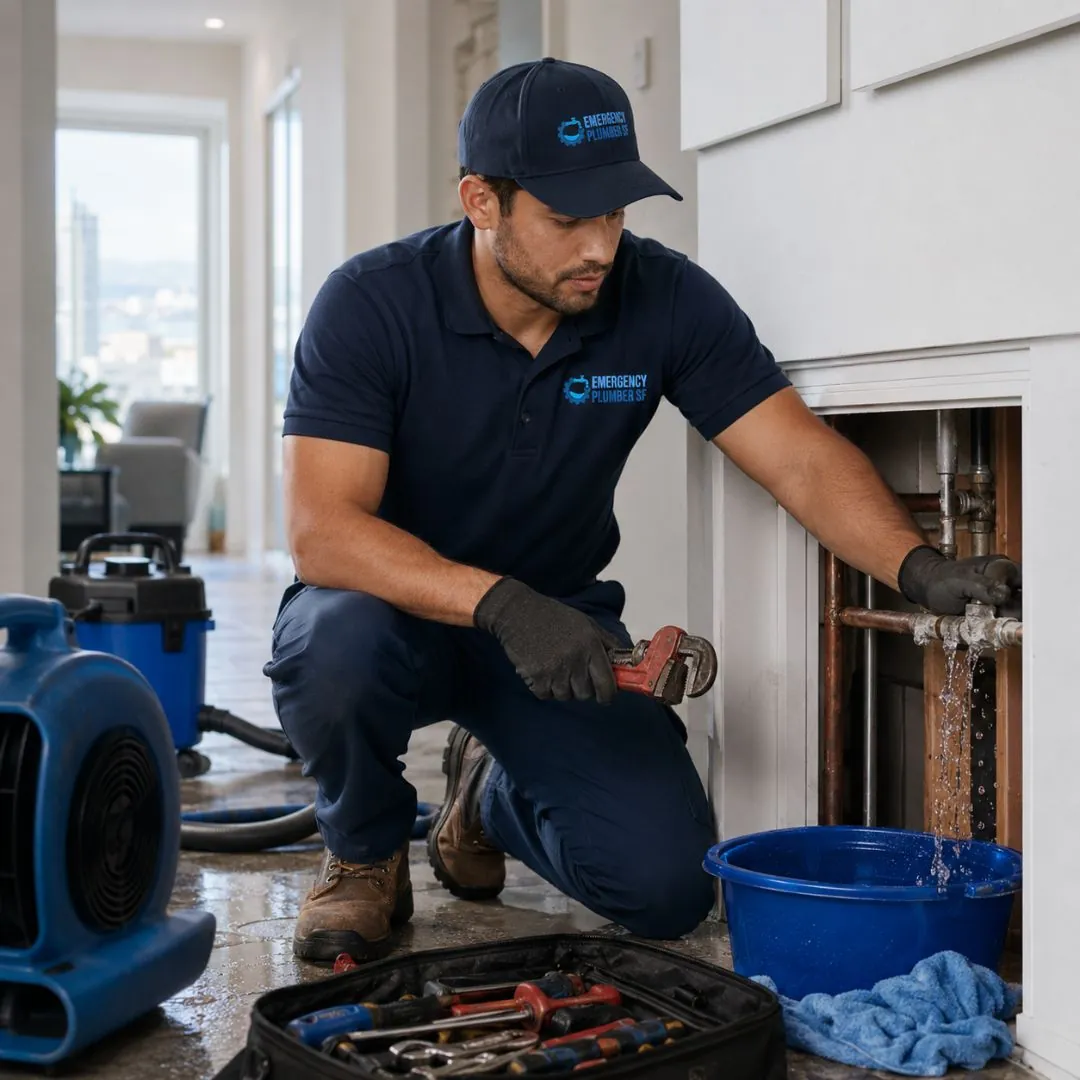
Five minutes of the right action does more to limit water damage than anything that happens in the following hour, and it can limit the bill before a technician is even on the road.
In most San Francisco homes it is at the front of the property near the sidewalk, in a box at ground level, or in the garage. Find it now, before you need it, and check the valve actually turns.
Toilets, sinks, and most appliances have their own stop valve. If the problem is confined to one fixture, closing that valve avoids shutting off the whole building.
If the tank is leaking, close the cold inlet valve and turn the unit off at the gas control or the breaker. A tank draining onto a floor does not stop on its own.
If water is near outlets, a panel, or ceiling fixtures, cut those circuits at the breaker, and only if you can reach it safely and dry. If you cannot, wait outside.
With a suspected sewer backup, stop running water anywhere in the building, including the washing machine and dishwasher. Every litre you add comes back up somewhere.
Before you move anything or start mopping. In any emergency situation the first ten minutes matter most. If this becomes an insurance claim, the photographs taken in the first ten minutes are the evidence, and they cannot be recreated later.
Residential plumbing services and commercial plumbing service, from a single blocked fixture through to full lateral replacement. An emergency plumbing service call is dispatched the same way at 3am as at 3pm. Comprehensive plumbing services available 24 hours a day, every day of the year. Emergency services are dispatched first.
24 hour dispatch for anything that cannot wait: uncontrolled water, backups, and total loss of supply.
Learn more →Emergency pipe work on failed supply lines, including in-wall and under-floor repairs.
Learn more →Drain cleaning service using cabling and jetting for blocked fixtures, branch lines, and main lines, with camera work where needed.
Learn more →Diagnosing and repairing the sewer line and lateral, including root intrusion and collapsed sections.
Learn more →Acoustic and thermal locating for a concealed plumbing leak behind walls, under slabs, and beneath floors.
Learn more →Repair and replacement for tank and tankless units, including permits and seismic strapping.
Learn more →This is the single most valuable thing on this page, and almost nobody in the trade explains it.
Your sewer lateral is the pipe running from the building out to the city main under the street. In San Francisco the property owner owns the entire lateral, which surprises people. But it splits into two sections, and who pays for repairs differs between them.
| Section | Where it runs | Who repairs it |
|---|---|---|
| Upper lateral | Building out to the face of the curb, including the vent and the trap | The property owner, using a licensed contractor |
| Lower lateral | Curb out to the sewer main in the street | Under most circumstances the SFPUC, at no extra cost to you |
That second row matters enormously. If an inspection shows the problem is in the lower lateral, the route is to report it through 311, which alerts the SFPUC's sewer operations team to inspect. Where they determine work is needed on the lower section, under most circumstances they carry it out. People pay contractors for that work every year without ever being told the city would have done it.
A few practical points if the work is yours. Anything past the trap toward the roadway needs a side sewer permit from San Francisco Public Works, and the contractor must hold the right licence class: an A, or a C-36 combined with a C-12, or a C-42. The portion from the trap back to the property is inspected by the Department of Building Inspection. And 811 must be called at least 72 hours before any excavation. A contractor who is vague about any of that is not the one to use.
Worth knowing separately: the SFPUC treats backwater valves as the owner's responsibility, and properties that have had sewage backup during heavy rain may be eligible for a reimbursement programme toward installing one.
General information, not legal advice. Confirm current requirements with SFPUC, SF Public Works, and the Department of Building Inspection for your property.
San Francisco plumbing takes unusual punishment, and the plumbing challenges here follow recognisable local patterns rather than random bad luck. These are the failures any plumber San Francisco property owners call will see week after week.
An enormous share of the housing stock went up in the decades after the earthquake, with galvanized steel supply lines. Those corrode from the inside and eventually fail as pinholes inside walls, often after decades of quietly narrowing.
Original laterals in older neighbourhoods are clay or cast iron. Clay joints separate and admit roots; cast iron scales and cracks. Both produce repeat backups that cabling only buys time against.
Mature street trees find any crack in a lateral and fill the pipe. This is the single most common cause of a main line backup in the older districts, and it recurs on a predictable cycle.
Parts of the eastern city sit on made ground. Settlement over decades pulls joints apart and creates bellies in laterals where waste collects rather than flowing away.
Ground-floor and below-street units sit lower than the sewer main in places, so a backup in the line finds those fixtures first. A backwater valve is the usual defence.
Heavy rain puts the system under pressure, and properties with compromised laterals or low fixtures are the ones that discover it. Backups cluster in the wet months for exactly this reason.
Understanding which of these applies to your building changes the recommendation. A galvanized supply failure means the rest of that pipework is the same age. A root intrusion means the lateral will block again on a cycle unless the defect is repaired rather than cleared. Cabling a line and saying nothing about why it blocked is how a customer ends up paying for the same plumbing repair three winters running.
Most of what we get called out to at 2am was preventable at some point, usually cheaply. A little plumbing maintenance buys real peace of mind, and these plumbing solutions need no professional at all. Prevent emergency call-outs and you save the premium entirely.
Turn the main and every fixture stop valve once a year so they do not seize. A valve that will not close during a flood is the difference between a mop and a claim.
Braided supply hoses on washing machines and dishwashers have a service life of roughly five to seven years. They are cheap, and a failed one empties at mains pressure until someone notices.
A plumber in San Francisco can fix plumbing faults you cannot see. If your building is older or has backed up before, a camera inspection tells you whether you have roots, a belly, or scale. That turns a recurring plumbing issue into a one-time fix.
Grease solidifies, wipes do not break down whatever the packet says, and both are behind a large share of main line blockages in this city.
Rust at the base, weeping at fittings, or water in the drip pan means the tank is on its way out. Planned replacement costs the same as an urgent one without the flooded floor.
If the supply lines in your home's plumbing are original galvanized, the first pinhole is a warning rather than a one-off. Budgeting for the work beats paying for three separate repairs.
If you are not sure what your building has, that is a reasonable thing to ask about on a routine visit. Knowing the age and material of your plumbing system is genuinely useful information to have before something fails, and it is the kind of thing plumbing experts should tell you without being asked.
Serving San Francisco and the wider Bay Area, we reach every San Francisco neighborhood, including the Mission District, SoMa, the Financial District, Chinatown, North Beach and the Marina, Pacific Heights, Noe Valley, the Castro, the Richmond and Sunset Districts, and Bayview Hunters Point, along with Daly City, South San Francisco, San Bruno, Millbrae, Burlingame, San Mateo, Pacifica, Oakland, Berkeley, and Alameda.
As a trusted San Francisco plumber operating throughout San Francisco and near San Francisco in the Peninsula and East Bay, we see the full range, and our emergency plumbing team handles urgent plumbing work across the whole footprint. Building age, pipe material, and even sewer rules vary a great deal across that footprint. A pre-war flat in the Mission is a different job from a tower unit in SoMa, and the East Bay operates under an entirely different sewer lateral programme from San Francisco. San Francisco properties of every age, and Bay Area buildings further out each get assessed on what they actually are. Whatever your emergency plumbing needs, we are ready to help. Plumbing emergencies happen everywhere, and San Francisco emergency plumbing is what we do every day.
See all service areas
Before you call an emergency plumber, know this: if it can wait until morning and save you an after-hours premium, we will say so. That costs us a call-out and earns the next one.
We respond quickly to emergency calls, with the call-out fee and rate confirmed on the phone, and a written scope on site before work begins. No figures invented at the kitchen table.
The experienced plumbers we dispatch hold current state licensing and carry insurance. Ask for the number and verify it with the licensing board; that takes a minute and is worth doing with anyone.
Our plumbing technicians explain not just what was cleared but why it blocked, and whether it will block again. A cleared line with no diagnosis is a repeat visit waiting to happen.
Post-quake galvanized supply, clay laterals, fill ground in the eastern districts, and garden units below street level each behave differently.
Expert plumbers should be able to explain what was found, what it means, what the options cost, and where the limits of the work sit, without jargon or pressure.
Expect a call-out or diagnostic fee of roughly $150 to $400 before any work starts, with evenings, weekends, and holidays carrying a surcharge over standard rates. Clearing a blocked fixture commonly runs $250 to $700, a main line clearing $400 to $1,200, and an accessible burst pipe repair $400 to $1,500. Always ask whether the diagnostic fee is credited against the repair, because many firms do that and not all of them volunteer it.
Anything where waiting causes damage, makes the property uninhabitable, or creates a risk. Water you cannot stop, sewage backing up indoors, no water at all, a steadily leaking water heater, and the only toilet in the home blocked all qualify. A single slow drain, a dripping tap, or a running toilet do not, and calling those in after hours means paying a premium for something that could have waited.
Usually not if it is one fixture and the others run normally, which points to a local blockage that can wait for a standard appointment. It becomes urgent when several drains back up at once, when a toilet gurgles as the washing machine drains, or when water comes up somewhere you did not run it. Those point at the main line rather than the fixture.
You own the entire lateral, but responsibility for repairs splits. The upper lateral, from the building out to the face of the curb including the vent and trap, is the owner's to repair using a licensed contractor. The lower lateral, from the curb to the main in the street, is under most circumstances repaired by the SFPUC at no extra cost, and the way to start that is a report through 311.
No. 911 is for fire, medical, and crime. For a burst pipe or a backup, call a plumber. If you smell gas, leave the building first and call the gas utility from outside rather than from indoors. For water or sewer problems in the public street, San Francisco takes reports through 311 around the clock.
In most San Francisco homes it is at the front of the property near the sidewalk, in a ground-level box, or inside the garage. Older buildings sometimes have it in a basement or under the front steps. Find it before you need it and check the valve actually turns, because a seized valve discovered during a flood is a much worse problem than a stiff one discovered on a Sunday.
A water bill that rose with no change in use, the sound of running water with every fixture off, warm patches on a floor, staining or bubbling paint, a persistent musty smell, reduced pressure, or a water meter that creeps when nothing is running. Any one of those justifies a leak detection visit before damage becomes visible.
It depends on time of day, traffic, and how many calls are already in the queue during a storm. What matters more than a promised number is being told a realistic window and being updated if it changes. Be sceptical of a guaranteed arrival time offered before anyone has checked where the nearest crew actually is.
Generally not. Caustic drain products often fail to clear a real blockage, can damage older pipework, and create a hazard for whoever opens the line afterward. If you have already used one, say so when you call, because it changes how the work is approached. A plunger and patience are a safer first attempt.
Often yes. Water heater replacement, repiping, and drain and vent alterations generally require a permit through the Department of Building Inspection. Work on the lateral past the trap toward the street needs a side sewer permit from San Francisco Public Works, and the contractor must hold the right licence class. Confirm who is pulling the permit before work begins.
Because clearing a line is not the same as fixing why it blocked. Root intrusion through a cracked clay lateral, a belly where the pipe has settled, or scale in old cast iron will all recur on a cycle after cabling. A camera inspection after clearing shows which of those you have, and that is the difference between an annual call-out and a repair.
In a rental, the owner is generally responsible for maintaining the plumbing in working order, and San Francisco has strong tenant protections. Report the problem in writing and keep a dated copy, because the duty to repair turns on notice. If it is an active emergency, deal with the water first and sort out responsibility afterward.
Know where your shutoffs are and test them yearly. Replace braided appliance hoses every five to seven years. Have the lateral camera-inspected if you are in an older building or have had a backup before. Do not put grease or wipes down any drain. If the supply lines are original galvanized, plan the repipe rather than waiting for the third pinhole.
Yes. Commercial work brings its own constraints: occupied premises, restricted hours, shared risers serving several tenancies, and grease interceptors in food service. The technical work is familiar; the scheduling and access planning is what makes it different, so raise those constraints on the first call rather than on the day.
Ask for the licence number and verify it directly with the California Contractors State License Board, which takes about a minute online. Confirm the classification is right for the job, plumbing work being a C-36 and sewer laterals requiring specific combinations. Also confirm liability cover and workers compensation, since an uninsured crew injured on your property becomes your exposure.
Not sure whether it can wait until morning? Start with an evaluation and a clear conversation about the property. One quick call is usually all it takes.
Quick, simple, and no obligation